AI Ad Campaign Case Studies: Real Results by Business Type
August 13, 2026
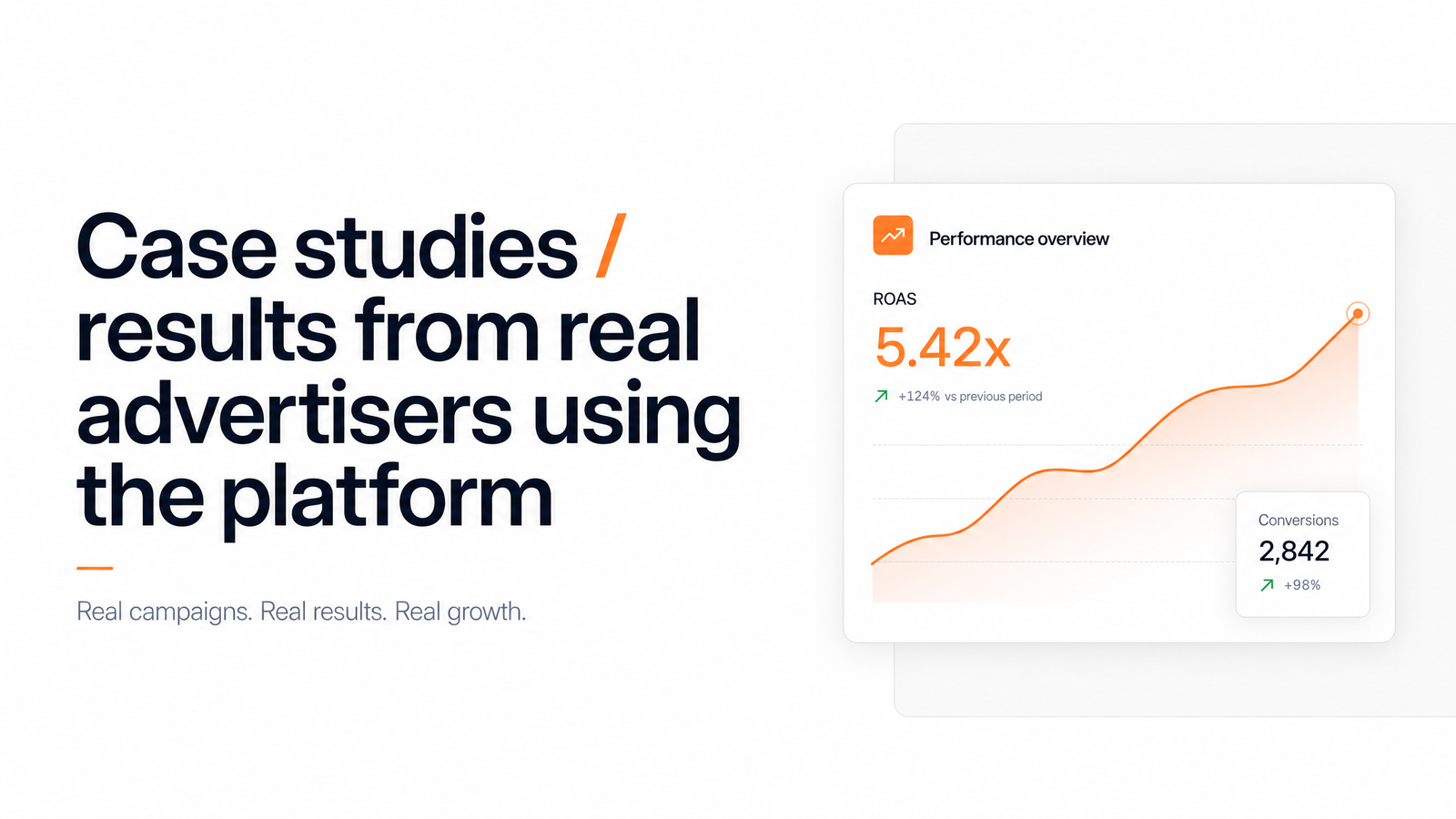
Most vendor case studies show one glowing logo and an unverifiable percentage. Instead, this piece synthesizes documented, cross-industry AI ad campaign results across three realistic advertiser profiles — a lean e-commerce brand, a multi-location service business, and an agency managing dozens of client accounts — and names the exact automation levers behind each gain.
What "Results" Actually Means Across AI-Driven Ad Accounts
Before comparing numbers, it helps to agree on what's being measured: ROAS, CAC, hours saved on manual management, and incremental profit after ad spend and labor. AI PPC results cluster in a fairly consistent range, not a single miracle figure.
The most credible anchor comes from third-party research rather than a platform's marketing page: autonomous, AI-driven campaigns using Performance Max and Advantage+ style automation tend to deliver 18–32% higher ROAS than manual management. That's the benchmark worth holding onto — wide enough to reflect real variance, narrow enough to set expectations. Named, non-competitor examples reinforce that this isn't a one-off: documented cases at Scoutshop, Karaca, and Pilgrim's show measurable ROAS and revenue gains from AI-driven PPC across different verticals and starting points. The pattern is real; the exact number depends on your account's baseline, data volume, and where the manual process was weakest.
Pattern 1: Lean E-Commerce Brand — Cross-Channel Budget Shifting
Picture a direct-to-consumer brand spending across Google, Meta, and TikTok with one or two people managing all three dashboards by hand. The recurring bottleneck isn't creative or targeting — it's speed of reallocation. A human manager checks performance daily at best; budget sits in an underperforming channel for hours or days before anyone notices.
Cross-channel budget automation closes that gap by shifting spend toward the platform generating the best marginal return in near real time, rather than on a fixed weekly review. This is the core mechanism behind most ecommerce AI ad results: the ROAS gain isn't from better ad copy, it's from money moving faster to where it performs. Combined with automated bid adjustments within each platform, this is consistent with the 18–32% ROAS lift benchmark and the CAC reductions seen in the Scoutshop, Karaca, and Pilgrim's cases. For a lean team, budget decisions that used to require a spreadsheet and a Tuesday morning review now happen continuously, without anyone touching a dial.
Pattern 2: Multi-Location Service Business — Consistent Execution at Scale
A multi-location business — a regional dental group, a home services franchise, a chain of gyms — faces a different problem: not the channels, but the sheer number of near-identical campaigns. Fifteen locations means fifteen sets of budgets, geo-targeting rules, and bid adjustments, and manual management inevitably means some locations get more attention than others.
This is where local ads automation results diverge from the e-commerce pattern. The headline metric isn't ROAS alone — it's consistency and time saved. AI-driven multi-location PPC applies the same optimization logic uniformly across every location simultaneously, so the tenth location gets the same quality of bid management as the first. That uniformity removes a hidden source of underperformance: campaigns that quietly stagnate because no one revisited them after launch. The CAC improvement shows up primarily in the long tail of locations that would otherwise have been neglected, not just the flagship ones a manager checks weekly.
Pattern 3: Agency Managing Multiple Client Accounts — Speed Without Headcount
Agencies face a version of the multi-location problem multiplied by client diversity: different industries, KPIs, and reporting formats, all competing for the same AdOps hours. Industry data on agency PPC automation is unusually direct about where the time goes: the 2026 Agency AdOps Benchmark Report documents significant hours lost per week to manual campaign setup, monitoring, and reporting, alongside meaningfully faster account launches once automation is introduced.
For agencies, the case for AI-driven management isn't primarily about ROAS — clients care about that too, but the agency's own economics hinge on scaling accounts without headcount. Automated campaign creation and bid management let account managers oversee more accounts at the same quality bar, converting hours previously spent on manual bid changes and budget pacing into margin or capacity for more clients. That's the number leadership needs when justifying a switch from a stack of point solutions to a unified platform.
Where Results Stall: The Conditions Behind Every Number
None of these gains are automatic. Three conditions determine whether an account lands in the benchmark range or falls short.
First, conversion tracking has to be clean. AI bidding and budget shifting are only as good as the signal they optimize against; broken pixels or incomplete multi-touch attribution mean the algorithm optimizes for the wrong thing. Second, there's a minimum data volume threshold — accounts with very low spend or conversion counts give the system too little signal to learn quickly. Third, every AI campaign learning period requires patience: budget spent in the first one to two weeks is partly the cost of letting the system establish a baseline, not wasted money, but it also won't show benchmark-level ROAS yet.
Ignore these conditions and the outcome flips. Research on 2026 PPC trends is candid that automation can underperform manual management by 30–50% in failure cases — almost always traced back to bad tracking, insufficient data, or expecting week-one results. Understanding why AI ads underperform is the mirror image of understanding why they work; the levers are the same, just absent. For a deeper, math-first breakdown of how spend, tracking, and timelines interact, see the comparison of Promevra against manual campaign management.
How Promevra Applies These Levers to Your Account
Every lever discussed above — cross-channel budget shifting, consistent multi-location execution, and reduced per-account labor for agencies — maps directly to specific Promevra capabilities: cross-platform orchestration across Google, Meta, and TikTok, automated creative rotation that retires underperforming ads without manual review, and rule-based budget automation that reallocates spend continuously rather than on a weekly cadence.
Promevra results follow the same mechanism described above, applied through one AI campaign automation platform instead of stitched-together point tools. For readers who want the mechanics rather than the outcomes, Promevra's step-by-step explainer covers exactly how the AI builds and launches campaigns from brief to live account.
See These Patterns on Your Own Account
The honest next step isn't to take these ranges on faith — it's to benchmark your own account against them. Compare your current ROAS and CAC to the 18–32% improvement range cited above, check whether your tracking and data volume meet the conditions described, and estimate the hours your team or agency currently spends on manual bid and budget work.
Promevra offers a demo and account audit built around exactly that comparison, mapping your current spend and metrics against the benchmarks in this article before you commit to anything. If you'd rather see the numbers first, start with a Promevra demo or AI ad platform trial and let the audit do the talking.
Frequently Asked Questions
How much can I expect ROAS to improve after switching to AI-driven ad management?
Most documented cases show an 18–32% ROAS improvement over manual management, based on third-party benchmarking of autonomous, Performance Max/Advantage+ style campaigns. Where your account lands depends on baseline tracking quality, spend volume, and how much manual budget reallocation was already happening. Accounts with poor tracking or very low spend can fall outside this range entirely.
Do AI campaign automation results look different for e-commerce versus local service businesses?
Yes — e-commerce gains come primarily from faster cross-channel budget shifting between Google, Meta, and TikTok, driving ROAS and CAC improvements. Multi-location service businesses see gains more in consistency and time saved, since AI applies the same optimization uniformly across every location rather than concentrating attention on a few.
How long does it take to see measurable results after turning on AI optimization?
Expect a one-to-two-week learning period during which the system gathers enough conversion data to optimize accurately, with benchmark-level ROAS gains typically visible after that initial phase. Accounts with higher existing spend and clean conversion tracking tend to reach measurable results faster than low-volume accounts.
What data or setup do I need before AI automation can actually improve my campaigns?
Clean, verified conversion tracking and a minimum volume of spend and conversions are the two prerequisites that determine whether automation succeeds. Without accurate tracking or multi-touch attribution, the AI optimizes against the wrong signal, and without sufficient data volume, it can't learn fast enough to outperform manual management.
Can AI automation actually save an agency time, or does it just shift the work?
It saves time — agency benchmark data shows significant weekly hours previously lost to manual campaign setup, monitoring, and reporting, plus faster account launches once automation is introduced. That time reduction is what lets agencies scale the number of accounts they manage without adding headcount proportionally.
What causes AI-driven campaigns to underperform manual management?
Broken or incomplete conversion tracking, too little spend or conversion data, and impatience during the initial learning period are the three most common causes. Research on PPC automation trends shows failure cases can underperform manual management by 30–50%, almost always traceable to one of these three conditions rather than a flaw in the automation itself.