Attribution Marketing Software: What It Does in 2026
August 9, 2026
What Attribution Marketing Software Actually Does
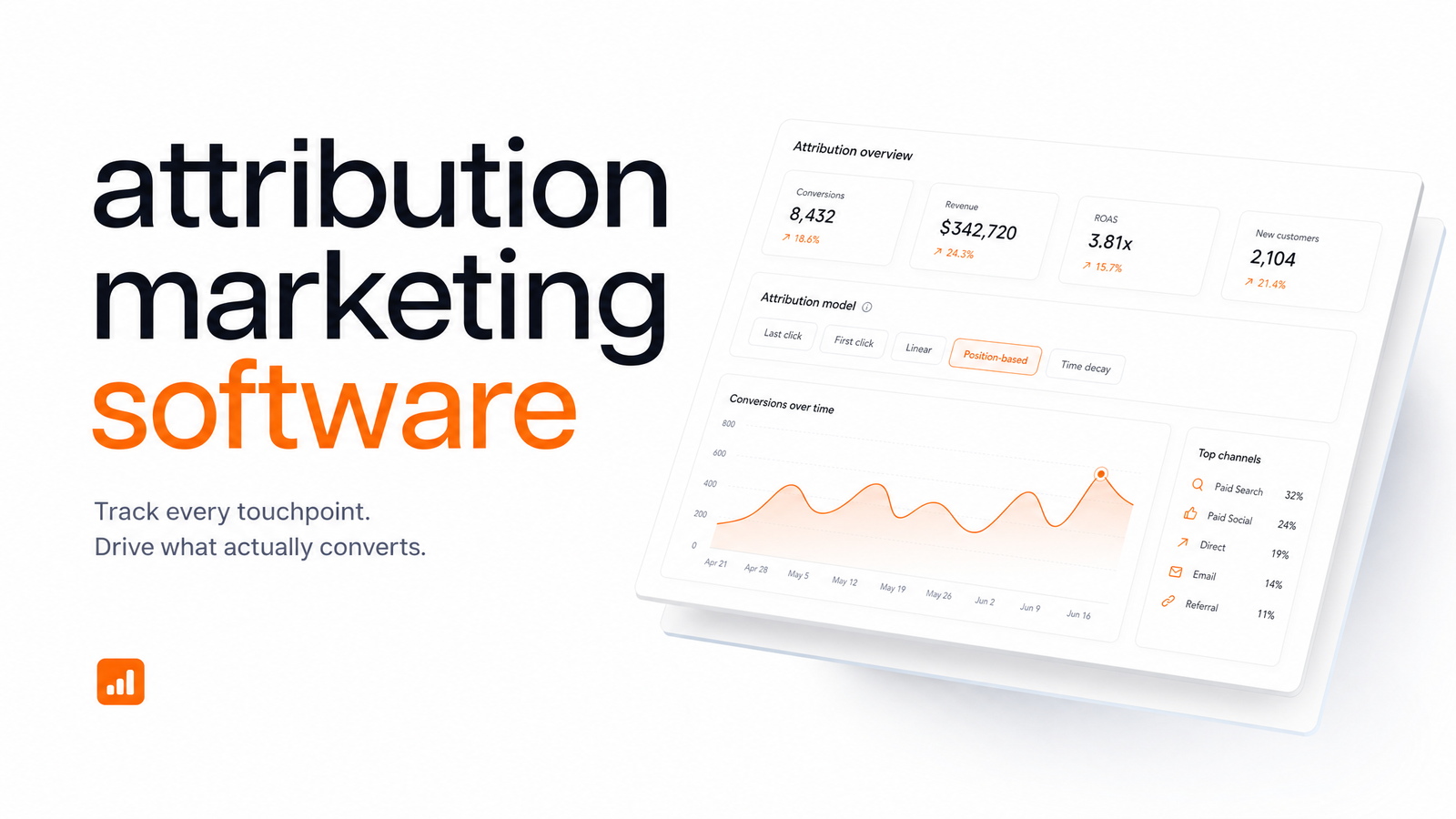
Attribution marketing software tracks the touchpoints a customer interacts with — ads, emails, organic search, social posts — and assigns credit for a conversion across them, instead of trusting whatever number each ad platform reports about itself. Google Ads, Meta, and TikTok all have an incentive to claim credit for the same conversion, and left unchecked, a marketer relying on platform dashboards alone will consistently overcount total conversions and misjudge which channel deserves budget.
Marketing attribution solves this by stitching together the customer journey — sometimes through pixel and cookie-based tracking, increasingly through server-side data, CRM records, and modeled statistical inference — and producing a single, cross-platform view of what drove a sale or lead. The output is usually a dashboard: spend by channel, credited conversions by channel, and a blended cost-per-acquisition meant to be more honest than any single platform's self-reported metrics. For a business spending money on Google, Meta, TikTok, and maybe programmatic display simultaneously, this cross-channel visibility is the baseline requirement for sane budget decisions.
The Main Attribution Models, Explained Simply
"Model" just means the rule a tool uses to divide conversion credit among touchpoints. The choice of model changes which channels look good or bad in your reporting, so it's worth understanding the basics before comparing tools.
First-touch attribution gives 100% of the credit to the first interaction a customer had with your brand — useful for understanding what drives awareness, but blind to everything that happened afterward. Last-touch attribution does the opposite, crediting only the final click before conversion; it's simple and still the default in many platforms, but it systematically overvalues bottom-funnel channels like branded search and retargeting. Linear attribution splits credit evenly across every touchpoint — fairer in spirit, but it treats a passive impression the same as an active click. Time-decay attribution weights credit toward touchpoints closer to the conversion, which suits shorter, urgency-driven sales cycles. Data-driven attribution uses statistical modeling to assign credit based on actual patterns in your conversion data, rather than a fixed rule — the closest thing to an objective answer, though it requires enough conversion volume to be statistically meaningful.
Multi-touch attribution (MTA) is the umbrella term for any of these models that consider more than one touchpoint. It's the standard most serious cross-channel attribution setups are built on today.
Why Attribution Got Harder (and Why MTA Alone Isn't Enough in 2026)
Multi-touch attribution depends on being able to see and connect individual user touchpoints — and that visibility has been steadily dismantled. Third-party cookies are gone or going in every major browser, iOS's App Tracking Transparency framework cut off a huge share of mobile-attributable data, and GDPR/CCPA-style regulation has made aggressive tracking a legal liability, not just a UX annoyance. The result is that MTA today works with a fraction of the signal it had five years ago, filled in with modeled and probabilistic data rather than direct observation.
That's why mature marketing teams stopped treating MTA as the whole answer. Marketing mix modeling (MMM) — a statistical, privacy-safe method that looks at aggregate spend and outcomes over time rather than individual user paths — has come back into favor precisely because it doesn't depend on cookies or device IDs at all. MTA and MMM answer different questions: MTA is granular and near-real-time but increasingly incomplete; MMM is directionally trustworthy and privacy-proof but slower and less tactical. Incrementality testing — holding out a control group to measure true lift — fills in gaps both approaches miss. The 2026 best practice isn't picking one; it's running MTA and MMM together as a "unified marketing measurement" stack, cross-checking one against the other rather than trusting either in isolation.
What to Look for in Attribution Software
Once you accept that no single model tells the whole story, evaluating attribution software becomes less about which vendor has the prettiest dashboard and more about a functional checklist:
- Cross-platform data ingestion — can it pull spend and conversion data natively from Google, Meta, TikTok, and other channels without manual exports?
- Flexible, custom modeling — does it support data-driven and custom-weighted models, not just last-touch defaults?
- Real-time or near-real-time reporting — daily-lagged data is close to useless when platforms adjust delivery hourly.
- CRM and ad-platform integration — attribution is only as good as the offline and online data it can connect.
- Incrementality or MMM support — a tool built only for MTA is already behind where measurement needs to be in a cookie-restricted world.
- The ability to act, not just report — this is the attribution software feature most listicles skip entirely, and it's the one that determines whether the tool changes your results or just documents them.
The Gap Attribution Software Doesn't Close
Here's the part most attribution vendors would rather not dwell on: a dashboard, however accurate, doesn't spend the budget for you. Someone still has to look at yesterday's data, decide that TikTok is underperforming and Google Search is outperforming, and manually shift dollars, adjust bids, and pause underperforming ad sets — across every platform, every day. Most attribution tools stop at measurement, leaving the actual reallocation to a marketer working in spreadsheets and platform UIs, reacting to data that's often already a day old by the time a decision gets made.
That's the real two-part problem: attribution answers "what happened," but performance depends on how fast and how well someone acts on that answer. This is precisely where AI attribution software and automated campaign optimization start to matter — tools that don't just surface the insight but execute the reallocation themselves, continuously, across platforms, without waiting for a human to open five tabs and make five separate judgment calls. Promevra's AI orchestration layer is built for exactly this handoff: it ingests cross-channel performance data and automatically shifts budget and bids in response, closing the loop that attribution alone leaves open. For a deeper look at how that decision-execution process actually works, see how Promevra's AI creates campaigns step by step, how it handles Google Ads orchestration above Performance Max, and the broader case for AI-driven optimization versus manual PPC management.
Frequently Asked Questions
What is the difference between attribution software and analytics software like Google Analytics?
Analytics software like Google Analytics measures on-site behavior and traffic sources for your own website, largely in isolation. Attribution software connects ad spend across multiple platforms to conversions, correcting for the fact that each platform overstates its own contribution. Attribution tools are built for cross-channel budget decisions; general analytics tools are built for understanding on-site user behavior.
Is multi-touch attribution still reliable now that third-party cookies and iOS tracking are restricted?
Multi-touch attribution is directionally useful but no longer complete on its own, because cookie deprecation and iOS App Tracking Transparency have removed much of the direct user-level data it relies on. Most mature teams now pair MTA with marketing mix modeling or incrementality testing to validate its findings. Treat MTA output as a strong signal to cross-check, not a final answer.
Which attribution model should I use for a short sales cycle vs. a long B2B sales cycle?
Time-decay or last-touch models generally suit short, impulse-driven sales cycles because the final touchpoints closely reflect what actually drove the purchase. Long B2B sales cycles benefit more from linear or data-driven models, since many touchpoints across a multi-month journey each contribute meaningfully to the eventual deal. Data-driven attribution is the safest default once you have enough conversion volume to support it.
Can attribution software automatically shift ad budget between platforms, or does it just report data?
Most attribution software only reports and visualizes data — it does not execute budget or bid changes itself. Shifting spend across platforms based on that data typically requires a separate optimization or automation layer, which is the gap AI orchestration platforms like Promevra are built to close.
Do small businesses need attribution software, or is it only worth it for large ad budgets?
Small businesses running paid ads on more than one platform still benefit from attribution, because even modest budgets get misallocated when decisions rely on each platform's self-reported numbers. The complexity of the model matters more at scale, but the basic need for cross-channel visibility applies at almost any budget size.
How does attribution marketing software work when a customer sees ads on Google, Meta, and TikTok before converting?
The software tracks each interaction the customer has across those platforms, using pixels, server-side events, or modeled data, and links them to a single conversion event. It then applies an attribution model — such as linear, time-decay, or data-driven — to divide credit for that conversion among Google, Meta, and TikTok, producing a blended view instead of three conflicting, platform-reported claims of full credit.
Attribution software will tell you exactly what happened across every platform — but it won't act on it. Closing that gap means pairing measurement with a system that reallocates budget and bids in real time, every day, without waiting on a person to catch up. See how Promevra turns cross-channel attribution data into automated action.