Programmatic Advertising Platform: What It Is & What It
August 12, 2026
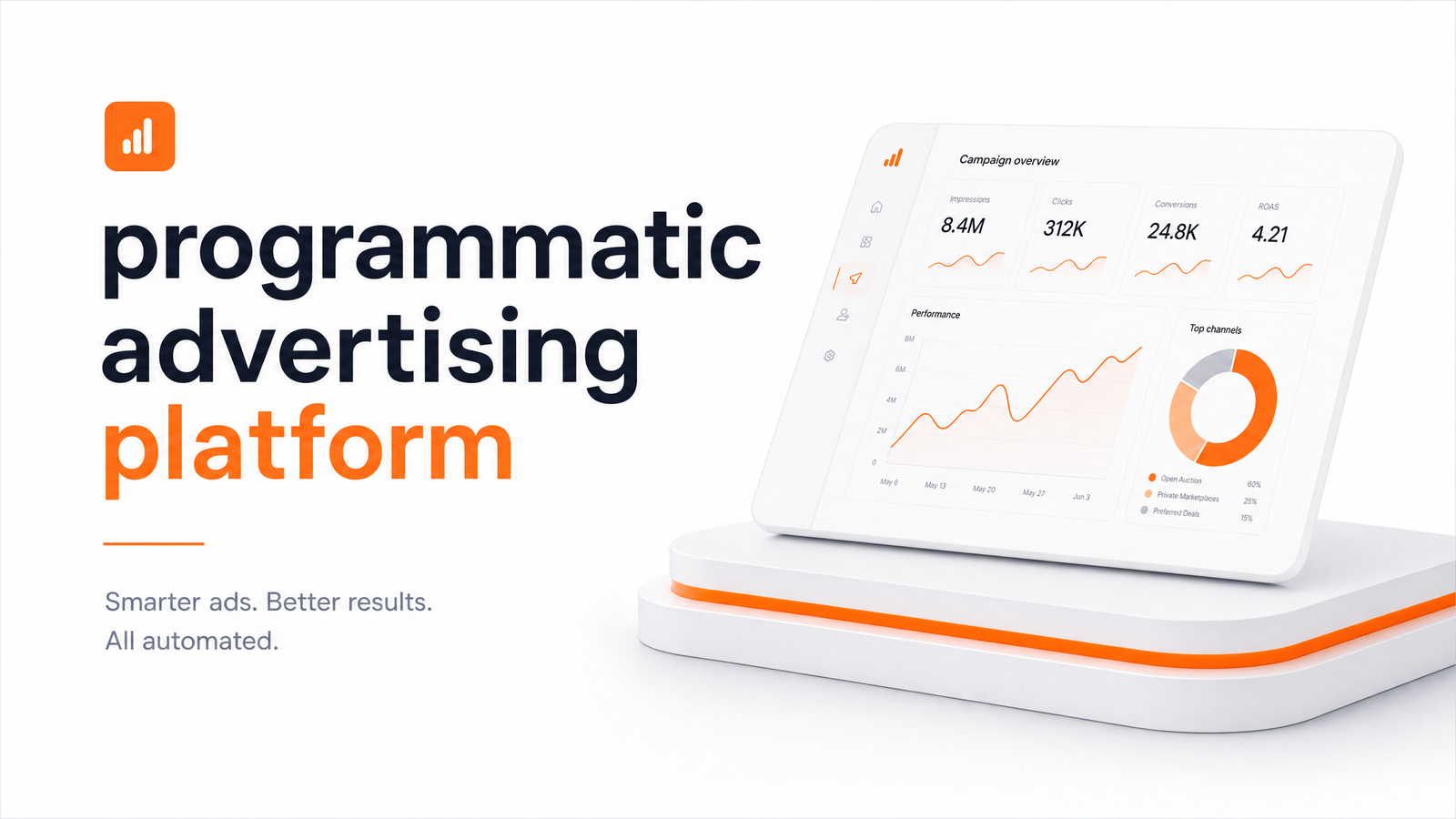
What Is a Programmatic Advertising Platform?
A programmatic advertising platform is software that automates the buying and selling of digital ad inventory through auctions, rather than a negotiated deal between a human buyer and publisher. That's the whole concept — everything else is mechanics and vocabulary.
In practice, it's the infrastructure connecting three roles: advertisers who want to buy impressions, publishers who want to sell them, and the marketplace that matches the two in the time it takes a webpage to load. The three building blocks worth knowing are the demand-side platform (DSP), which lets advertisers bid on inventory; the supply-side platform (SSP), which lets publishers offer inventory to multiple buyers; and the ad exchange, where those bids and offers actually meet. TechTarget's overview is a solid, vendor-neutral reference for the deeper technical definition.
This is the open web — the vast collection of sites, apps, and streaming services that don't operate a closed advertising ecosystem of their own. It's distinct from advertising inside Google, Meta, or TikTok's own platforms, a distinction we'll untangle later.
How Programmatic Ad Buying Actually Works
Real-time bidding (RTB) is the auction mechanism that makes programmatic buying possible, and the flow is more intuitive than the acronyms suggest. A user loads a webpage with an open ad slot. In the milliseconds before it renders, the publisher's SSP sends an "impression request" to the ad exchange, describing the slot and whatever anonymized visitor data is available. The exchange broadcasts that request to connected DSPs. Each DSP instantly checks its advertisers' targeting rules and budgets, decides whether the impression is worth bidding on, and submits a bid if so. The exchange picks the winner, that ad is served, and the whole sequence — request, auction, win, serve — finishes before the page finishes loading.
Outside pure RTB, two other deal types matter. Programmatic guaranteed lets an advertiser reserve a fixed volume of impressions at a fixed price, automated but not auctioned. A private marketplace (PMP) is an invite-only auction where a publisher offers premium inventory to a curated list of buyers instead of the open exchange. Both still count as programmatic because software executes the transaction, even without a live bidding war. Amazon Ads breaks down the DSP/SSP mechanics well if you want a second explanation of the bidding sequence.
DSPs, SSPs, and Ad Exchanges: The Main Types of Platforms
Shopping for a programmatic advertising platform means bumping into several categories that solve different problems. The DSP is built for advertisers and agencies — it centralizes bidding, targeting, and reporting across many publishers and exchanges at once. Google's Display & Video 360 and The Trade Desk are two of the most recognized DSPs, and Amazon DSP has become a major player thanks to its retail and shopping data.
The SSP serves the other side of the table: publishers use it to package ad slots, set floor prices, and expose inventory to as many demand sources as possible to maximize yield. The ad exchange sits between the two, running the actual auction infrastructure. Some agencies also operate an agency trading desk — a managed-service layer on top of a DSP, where the agency's team handles strategy and optimization on the client's behalf.
Layered over all of this is Connected TV (CTV) advertising, one of the fastest-growing programmatic categories, letting advertisers buy streaming inventory the same way they'd buy a banner ad. If your goal is reaching audiences across publishers, apps, and streaming services you don't otherwise have access to, this is the layer of the ad tech stack you're evaluating.
Is Search & Social Advertising "Programmatic" Too?
Not in the classic sense, and this is where a lot of marketing copy gets sloppy. Google Ads, Meta Ads, and TikTok Ads are automated and increasingly AI-driven — they run real-time auctions and adjust bids algorithmically. But they're closed ecosystems: you're bidding only within that platform's own inventory, against its own advertisers, through its own interface. There's no DSP, SSP, or open ad exchange involved. By the strict definition, Google Ads isn't programmatic — it's automated PPC (pay-per-click) auction advertising, not open-web programmatic buying.
The confusion is understandable because both models share automation, bidding, and data-driven targeting. The practical difference is inventory access: true programmatic gives you reach across the open web and countless publishers through one interface; search and social advertising gives you deep, high-intent reach within one company's walled garden. Programmatic advertising vs PPC isn't a matter of one being smarter — they solve different reach problems.
Open-Web Programmatic vs. AI Campaign Orchestration: Which Do You Need?
This is the decision that actually matters once the terminology is sorted out. If your goal is reaching audiences beyond Google, Meta, and TikTok — across news sites, apps, streaming services, or CTV — you need a true DSP and the programmatic buying infrastructure behind it. That's a different budget, skill set, and typically a different team or agency partner than running search and social campaigns.
If your actual challenge is managing and scaling the Google, Meta, and TikTok accounts you already run — building campaigns, testing creative, reallocating budget, and optimizing bids without a full-time team doing it manually — that's not an open-web programmatic problem. It's an AI advertising challenge of a different kind: applying automation and machine learning inside the channels you've already chosen. This is exactly where a platform like Promevra fits. Among programmatic advertising platform examples and adjacent AI tools, it's worth being clear that Promevra automates and optimizes campaigns within Google, Meta, and TikTok's own ad systems — it isn't a DSP buying open-web or CTV inventory. The two categories are complementary, not competing: a brand running CTV through a DSP might still want AI orchestration for its search and social spend, and vice versa.
How to Evaluate Any Programmatic or AI Ad Platform
Before requesting a demo of either category, run the same checklist:
- Inventory or channel access — open web, CTV, and specific publishers for a DSP; or Google, Meta, TikTok account-level coverage for an orchestration tool.
- Fee transparency — media cost versus platform/tech fees, and how they're disclosed.
- Optimization method — rules-based bidding versus true machine-learning optimization, and what data it's trained on.
- Reporting and attribution — whether results tie back to real conversions, not just impressions or clicks.
- Minimum spend and contract terms — some of the best programmatic advertising platforms carry high minimums that only make sense at agency scale.
Answering these five questions honestly will tell you which category — and which specific vendor — actually fits your budget and goals.
Frequently Asked Questions
Is Google Ads or Meta Ads considered programmatic advertising?
Not in the traditional sense. Google Ads, Meta Ads, and TikTok Ads run automated, real-time auctions, but they're closed ecosystems without a DSP, SSP, or open ad exchange involved, so they're more accurately described as automated PPC advertising rather than open-web programmatic.
What's the difference between a DSP and a programmatic advertising platform?
A DSP is one specific tool advertisers use to buy inventory programmatically; "programmatic advertising platform" is the broader category that includes DSPs, SSPs, and ad exchanges working together. Every DSP is part of the programmatic ecosystem, but the term covers more than just the buying side.
Do I need a programmatic advertising platform if I only run Google, Meta, and TikTok ads?
Generally, no. If your media spend is confined to those three platforms, you need better automation and optimization within those accounts, not open-web programmatic buying infrastructure — that's the gap AI orchestration tools are built to fill.
What are examples of programmatic advertising platforms?
Google's Display & Video 360, The Trade Desk, and Amazon DSP are among the most widely used demand-side platforms for buying open-web and CTV inventory programmatically. These differ from AI campaign tools that optimize spend inside Google, Meta, and TikTok's own ad systems.
Is programmatic advertising more expensive than regular PPC?
It depends on the inventory and fees involved rather than the buying method itself. Programmatic often includes additional tech and data fees layered on top of media cost, while search and social PPC pricing is generally more transparent since you're paying the platform directly.
Can AI campaign tools like Promevra work alongside a DSP?
Yes — they operate in different layers of the ad stack and don't compete for the same budget. A DSP handles open-web and CTV reach, while a tool like Promevra automates and scales the Google, Meta, and TikTok campaigns a business already runs, so both can be used together as part of a broader media strategy.
If open-web or CTV reach isn't actually what you're after, and what you really need is to stop manually managing Google, Meta, and TikTok campaigns, see how Promevra's AI creates campaigns step by step, or go straight to Promevra to see the platform for yourself.